
Most sales training was built for people who sell on Zoom. If your reps sell roofs, windows, HVAC, solar, or flooring at a kitchen table, half the tools on the market weren’t built for you.
That matters now because AI sales training has gone from a nice idea to a crowded category. Every vendor says their artificial intelligence will coach your team. Some of them will. Many will hand you a dashboard nobody opens.
This guide is for owners and sales managers who already know they need better training and are deciding what to buy. We’ll cover the three types of AI sales training tools, what each one is good for, the questions to ask before you sign, and how to roll one out without slowing your team down.
Why traditional sales training breaks down in the field
The classic sales training program for an in-home team looks like this: a week of classroom training, a binder with the playbook, a few ride-alongs, and then the new rep is on their own.
Here’s where it falls apart:
- Ride-alongs don’t scale. One manager can’t sit in on every appointment. Most reps get coached on a handful of calls a month, if that.
- Memory is a bad witness. By the time a rep tells you how the appointment went, the details that lost the deal are gone. You coach on their version of events.
- Classroom training fades. A rep can recite the pitch in the office and still skip the price anchor at the table. Without feedback on real customer interactions, good habits drift.
- Ramp time is expensive. Every week a new rep runs appointments below their potential costs you sits, closes, and leads you already paid for.
An LMS full of videos doesn’t fix any of this. It tells reps what to do. It can’t tell them what they actually did.
The three types of AI sales training tools
When people search for “sales training AI,” they land on three very different kinds of products. Know which one you’re shopping for.
1. AI sales roleplay
AI sales roleplay lets a rep practice against an AI buyer before they ever knock on a door. The tool uses generative AI to play a prospect. The rep talks, the AI pushes back in real time, and the rep gets instant feedback when the session ends.
Roleplay is useful for:
- Onboarding. New reps can run fifty practice appointments before their first real one.
- Objection handling. Reps can drill the objections they hear most (“I need to talk to my spouse,” “That’s more than I expected,” “I’m getting two other quotes”) until the answers come out clean.
- New offers. When you change pricing or messaging, or launch a new product, reps can practice the new pitch with zero risk.
What to watch for: most roleplay simulations were built for software sales. The AI characters act like a VP of IT on a discovery call or a gatekeeper on cold calls. That’s the wrong buyer. An in-home rep needs to practice with a homeowner who has a leaking roof, a tight budget, and a spouse who isn’t home yet. Ask the vendor to show you buyer personas for your trade, not generic B2B ones.
Some tools also lean hard on gamified leaderboards and badges. A little competition is fine. But points for finishing modules don’t move close rates. Practice that matches real appointments does.
2. Conversation intelligence
These tools record real sales conversations, transcribe them, and pull out patterns. Gong and Chorus are the best-known names.
They’re strong at what they do. The catch for field teams: they’re built around web meetings and dialers. They plug into Zoom, Teams, and your phone system. They have nothing for a rep standing in a living room. Most also sell on annual contracts sized for large inside-sales teams.
If your team sells over video, one of these is worth a look. If your team sells in person, you need a tool that captures the in-person appointment.
3. AI sales coaching on real appointments
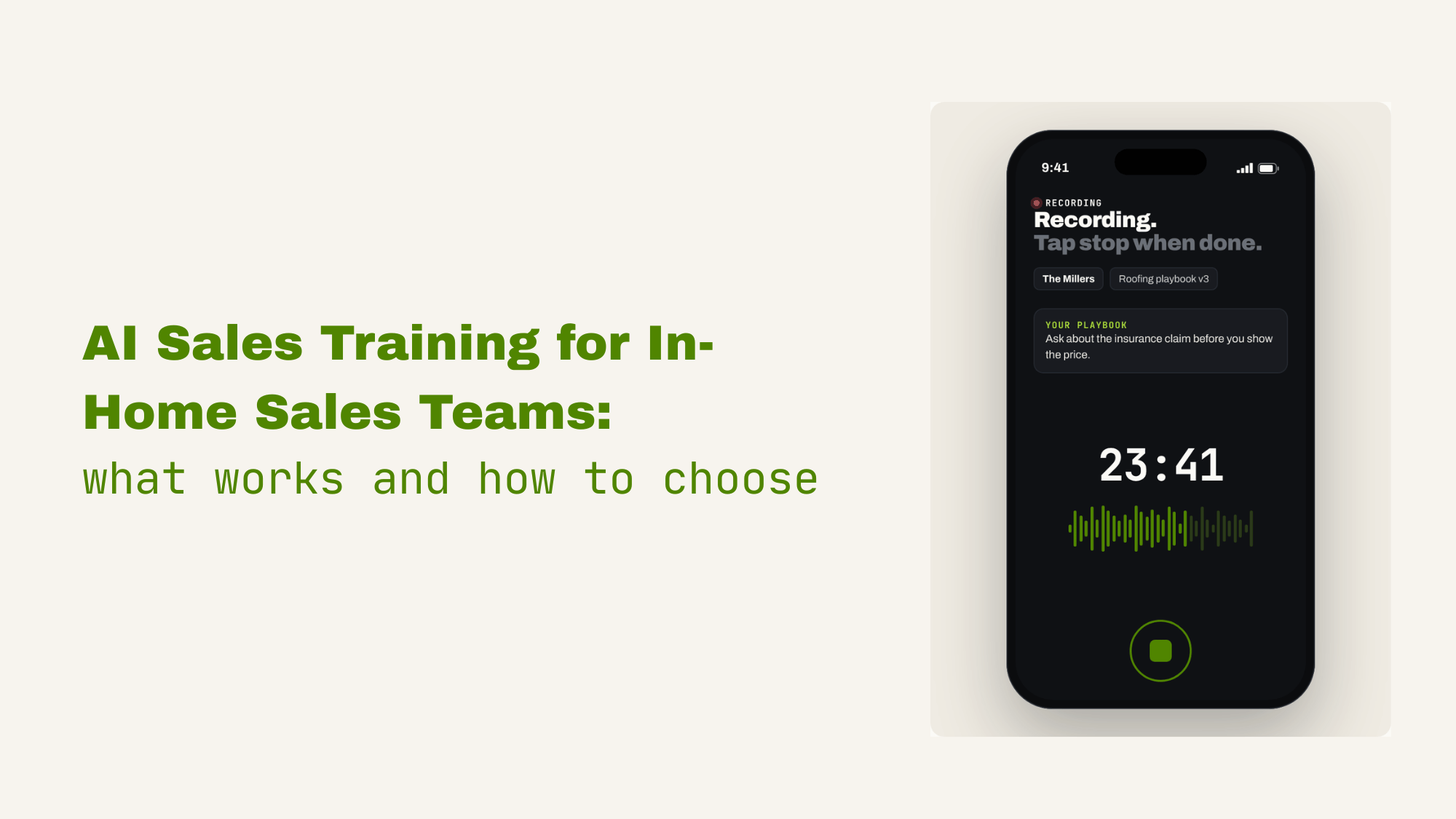
AI sales coaching closes the gap that roleplay and conversation intelligence leave open. The rep records the actual appointment on their phone. The AI grades it against your sales process and sends back specific, personalized coaching: what they did well, what they skipped, and the exact moment the deal turned.
This is the closest thing to having a manager on every ride-along. It’s also where the biggest gains in sales performance tend to come from, because the feedback is about real customer interactions with real money on the line.
What separates the good tools from the rest:
- It grades against your process. Your sales methodology, your steps, your messaging. Not a generic scorecard built for SaaS demos.
- It shows its work. Every score should point to a quote and a timestamp. If you can’t check why the AI gave a 62, you can’t coach from it.
- It’s fast. Feedback the same day, ideally before the rep’s next appointment. Coaching that shows up a week later is too late to change the next appointment.
- Reps actually use it. If recording takes more than one tap, it won’t happen.

Roleplay vs. real-call coaching: you probably need both
Think of AI sales roleplay as the practice field and AI sales coaching as the game film.
| AI sales roleplay | AI sales coaching on real calls | |
|---|---|---|
| Best for | Onboarding, new pitches, objection drills | Ongoing training, fixing habits, manager coaching |
| Buyer | AI personas | Real homeowners |
| Feedback | Instant feedback after practice | Scored appointment, same day |
| Finds | Whether a rep knows the pitch | Whether a rep runs the pitch when it counts |
| Risk | None | None added; the appointment happens anyway |
Roleplay builds the skill. Real-call coaching shows you whether the skill survives contact with a homeowner. The teams that get new reps up to speed fastest use roleplay in week one and switch most of their training to real appointments as soon as the rep starts running them.
How AI sales training helps reduce ramp time
New reps are where this pays back first. Here’s what changes:
Before. A new rep shadows for a week, then runs appointments alone. The manager hears about the ones that closed and the ones that blew up. Everything in between is a mystery. Skill gaps show up months later in the close rate.
After. The new rep practices the pitch against an AI homeowner until they’re comfortable. Then they record every real appointment. Each one comes back scored against your playbook. The manager sees in week one that the rep skips the needs assessment and goes straight to the product demo. They fix it in week one, not month three.

That’s how you cut onboarding time. The fix is finding skill gaps while they’re still small and coaching them on evidence.
What sales managers get out of it
This isn’t only for reps. For sales managers, the payoff is time and focus.
- Coach the right thing. Instead of asking “how’d it go?”, you open the appointment, see the score, and jump to the moment the price conversation went sideways.
- See patterns across the team. If four reps skipped the same step this week, that’s a training topic for Monday’s meeting, or a sign your sales strategy needs a tweak.
- Spend ride-alongs where they count. Use your in-person time on the reps who need it most, and let the AI cover the rest.
- Tie coaching to numbers. Track which steps show up in appointments that close, and coach toward win rates and average deal size, not gut feel.

This is what sales enablement looks like for a field team. You don’t need a separate department. You need a clear process and a way to see whether reps follow it.
Buyer’s checklist: questions to ask any AI sales training vendor
Bring these to every demo.
- Was it built for in-person sales? Ask to see how a rep captures an appointment in a home. If the answer involves a Zoom bot or a dialer, it wasn’t.
- Can it grade against my process? You should be able to set your own steps and weights, or upload your sales process doc and have it turned into a scorecard.
- Does every score show evidence? Look for a quote and timestamp behind each piece of feedback.
- How fast is feedback? Real-time feedback in practice and same-day feedback on real appointments is the bar. Days is too slow to change behavior.
- What does the rep have to do? One tap to record is the bar. Note-taking or CRM fields after the call will kill adoption.
- Does it work offline? Basements and rural driveways have no signal. Recordings should upload when the rep is back on WiFi.
- How does it handle recording consent? The vendor should know the one-party and two-party consent rules and enforce them for you.
- What does it cost, and what’s the contract? Watch for seat minimums, setup fees, and annual lock-ins. Your ICP is a field sales team, not a 500-seat call center, and the pricing should match.
- How long until it’s live? If the rollout plan has phases and a kickoff call, ask why.
- Do roleplay personas match my buyers? If the tool includes AI sales roleplay, the AI homeowner should sound like your buyers, in your trade.
How AdaptClose does AI sales training for field teams
AdaptClose is AI coaching built for in-person sales teams: roofing, windows, HVAC, solar, flooring, pest control, and anyone else who sells at the kitchen table.
Practice with an AI homeowner. Our free roleplay toolThis file is outside this session’s folders, so it can’t be opened here. lets reps run a live voice roleplay against an AI homeowner in roofing, windows, HVAC, solar, or flooring. The homeowner pushes back with real objections, so reps can practice the pitch and the close before a real appointment.
Record the real appointment in one tap. The rep hits record when they get in the driveway and pockets the phone. It works offline and uploads when they’re back on WiFi.

Get a score with the receipts. About 15 minutes later, the rep gets a score, a breakdown by each step of your process, and a coaching tip with the exact quote and timestamp it’s based on. Same-day feedback on every appointment, without a manager in the truck.
Grade against your playbook. Set your own steps and weights, or upload your sales process doc and we’ll turn it into the scorecard. Smart defaults mean you get value before you customize anything.

Coach on evidence. Managers see every graded appointment in the web dashboard, spot which reps are skipping which steps, and send coaching tied to a real moment in a real call.
Built for small teams. $180 per rep per month. Month-to-month. No setup fee, no seat minimum, no implementation project. Add reps with a text invite and be grading real appointments the same afternoon.
FAQ
What is AI sales training?
AI sales training uses artificial intelligence to help sales reps build and sharpen skills. It usually takes one of two forms: AI sales roleplay, where reps practice against AI personas, and AI sales coaching, where real sales conversations are recorded, scored, and turned into personalized coaching.
Is AI sales roleplay worth it for in-home sales?
Yes, if the AI buyer acts like a homeowner and not a software buyer. Roleplay is most useful during onboarding and when you roll out new pricing or a new pitch. On its own, it can’t tell you whether reps run the pitch in real appointments, so pair it with real-call coaching.
Can AI replace ride-alongs?
It replaces the ride-alongs you can’t do. Most managers can only sit in on a few appointments a week. Real-call coaching covers every appointment, so you can save your in-person time for the reps who need it most.
How much does AI sales training cost?
It ranges widely. Enterprise platforms often require annual contracts and multi-week rollouts. AdaptClose costs $180 per rep per month, month-to-month, with no setup fee and no annual commitment.
Is it legal to record sales appointments?
In one-party consent states, a rep who is part of the conversation can record it. Two-party consent states have stricter rules. AdaptClose handles this on our side so your reps don’t have to guess.
Start grading appointments this week
Your best training material is the appointments your reps already run. Right now, almost none of them get reviewed.
Try it two ways without paying. Run an AI roleplay in your browser, no signup and no card. Or book a demo and we’ll walk your own sales process through the product.
From the blog


