
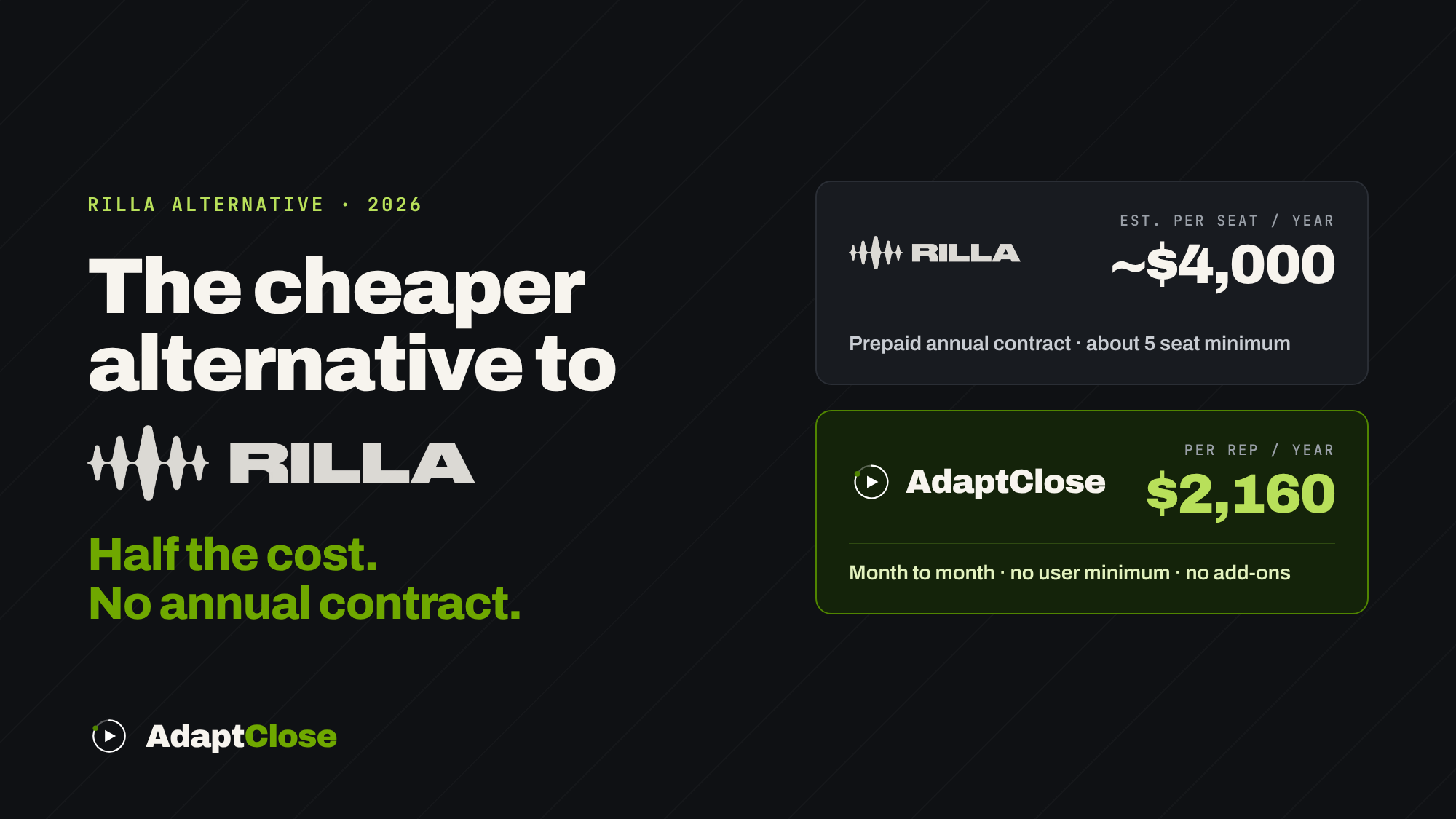
Short answer: The cheaper alternative to Rilla for a home services team is AdaptClose. It does the job you are buying Rilla for, recording the in-home appointment and grading it against your playbook, for $180 per rep per month. No annual subscription required. No minimum number of users. No paid add-ons. Independent estimates put a typical Rilla account near $4,000 per seat per year, paid up front, and reviewers say the extras cost more on top.
Most teams looking for a cheaper option like the idea. Virtual ridealongs work.
The problem is the deal around it. You cannot see the price, you cannot start small, and you pay for a year before your reps record a call.
What does Rilla cost?
There is no pricing page. The site has a demo button and nothing else, so every number you find is an estimate. Our full Rilla pricing breakdown has the details.
Sacra, an independent research firm, estimates the average contract at roughly $20,000 a year, with a minimum of about five seats, collected almost entirely up front. That works out to around $4,000 per seat per year.
One contractor on Capterra says they were held to $24,000 after quitting at 30 days because recording did not trigger reliably.
Here is that rate next to what AdaptClose charges:
| Team size | Rilla, est. per year | AdaptClose, per year | You keep |
|---|---|---|---|
| 5 reps | $20,000 | $10,800 | $9,200 |
| 10 reps | $40,000 | $21,600 | $18,400 |
| 15 reps | $60,000 | $32,400 | $27,600 |
| 25 reps | $100,000 | $54,000 | $46,000 |
Rilla figures are estimates based on Sacra’s reported contract value, since the company does not publish a price. AdaptClose is $180 per rep per month on our pricing page. Annual billing at $144 is optional, never required.
The estimates leave out the implementation fee, which buyers report at $1,500 to $5,000. AdaptClose has no implementation fee. Run your roster through the ROI calculator.
The annual contract is the expensive part
Home services headcount moves with the season. A yearly commitment with a fixed seat count bills you for your July roster all year, including every empty seat in winter.
Paying up front also kills your leverage. If reps stop recording in week three, you still own the other forty-nine weeks.
AdaptClose never requires an annual subscription, and there is no minimum number of users. One rep is a valid account. You pay per active rep, month to month. Add seats when you staff up in spring. Drop them in December. If it stops earning its keep, cancel at the end of the month.
What you are actually paying for
Most teams use the recording, the score, and the manager review. The price also funds what your team may never touch: Rilla Live, revenue intelligence dashboards, AI agents, and deep CRM integration. That is a wide product for a five-truck roofer to fund.
Rilla charges for add-ons. AdaptClose does not.
The seat price is not the whole bill.
A sales manager on Capterra lists “the gimmicky tokens and credits you have to buy” as a dislike, and says the upcharging is too much for their company. Nobody publishes what those credits cost.
The renewal is another surprise. A small business owner on G2 rated Rilla 1.5 out of 5 in a review titled “Buyer beware.” The owner planned to cancel when the auto renewal notice arrived, says it never came, and says Rilla refused to refund a $13,000 annual subscription.
AdaptClose has no add-ons to buy. No tokens, no credits. Unlimited recordings, scoring, live listen, roleplay, photos, and the dashboard are all in the $180.
| What you pay for | Rilla | AdaptClose |
|---|---|---|
| Annual subscription required | Yes (reported) | No, month to month |
| Minimum number of users | About five (reported) | None |
| Setup or implementation fee | $1,500 to $5,000 (reported) | $0 |
| Paid add-ons, tokens, or credits | Yes (reviewers) | None |
AdaptClose is built for home services only.

Every appointment is scored against your own playbook, step by step. The manager jumps to the 30-second moment a rep skipped a step. That is the ridealong, without the forty-minute listen.
Everything AdaptClose includes for $180
One price covers every coaching feature. Nothing is sold separately.
Graded appointments, same day. A 30-minute appointment comes back graded 5 to 10 minutes after upload, with the score and one tip on the rep’s phone before the next appointment.

Your playbook, not a generic scorecard. Upload the playbook you already have, even a PDF, and AdaptClose turns it into the rubric. No playbook yet? Start on a default rubric for your trade, or build one with the free playbook generator.

A dashboard that tells the manager who to coach. Team scores by step and which rep needs attention this week.

Live listen. Rilla Live is sold as a premium feature. AdaptClose includes live listen, so a manager can hear an appointment in progress from anywhere.

Also included: photo and video capture, visit checklists, door-to-door mode, offline recording, follow-up emails drafted from the call, and AI roleplay practice. You can try the roleplay tool right now with no signup.
The other Rilla competitors have the same problems
Shop the best Rilla alternatives and most of them copy the parts of the Rilla deal you were trying to escape. Our roundup of Rilla competitors goes deeper.
Siro: Rilla’s pricing model with a bigger seat minimum
Siro hides its price too. Estimates put Siro at $200 to $350 per rep per month on an annual deal, plus a $2,000 to $5,000 setup fee. The reported minimum is ten seats, double Rilla’s. A five-rep roofing company on Siro likely pays for ten seats anyway, which puts year one near $36,500 by our estimate. The same five reps cost $10,800 a year on AdaptClose. See our Siro pricing breakdown.
Siro’s headline feature is Halftime. At a break in the appointment, the rep opens the Siro app to see customer needs, missed discovery, and a closing plan. Halftime means stepping away from the homeowner to read a phone in the middle of the close. Siro has also raised about $75 million, including a $50 million Series B, and venture money that size pulls a roadmap toward bigger accounts than yours.
Choosing between the two? Read Rilla vs Siro or Siro vs AdaptClose. Switching to Siro moves the price problem without solving it.
SalesAsk: a price that changes depending on the page
SalesAsk targets home services too, but try to pin down what it costs. Its own comparison pages quote figures from $99 to $199 per rep, so you will not know your number until the demo.
The coaching runs through Coach Dean, an AI persona that scores your calls against SalesAsk’s model of a good appointment. You do not write the rubric. Ask in the demo whether Coach Dean lets you set your own steps and weights, and whether you can see the history when the scoring changes. SalesAsk’s site lists recording on iPhone, iPad, and Apple Watch, so if part of your crew carries Android, ask about that too. AdaptClose runs on any iPhone or Android phone.
SalesAsk does list native integrations with ServiceTitan, Jobber, and Housecall Pro, so it fits best if your team lives in one of them. See SalesAsk vs AdaptClose and our list of SalesAsk alternatives.
GhostRep: pay first, find out later
GhostRep sells prepaid hours with no subscription: $200 for 25 hours up to $1,000 for 250 hours. You pay before you get an account, and the site says no free usage is included. When we reviewed GhostRep, its G2 profile had no reviews, so you are buying on faith.
The prepaid hours never expire, but practice, prep, and live coaching all draw from one shared pool. Twelve reps practicing and running GhostRep Echo, its live earpiece coach, burn through prepaid hours fast, and next quarter’s bill is a guess. It is built to ramp new hires, not to grade your veterans’ real appointments. More in our GhostRep review.
Craft: built for the call center
This one is built around live prompts across the booking call center and the field, and it leans on ServiceTitan and Salesforce integrations. That works on short, scripted booking calls. A rep at a kitchen table for two hours is not reading prompts off a screen. Its trade list centers on HVAC, plumbing, remodeling, and painting, not roofing, solar, or windows. No public price, only directory estimates. See our head-to-head comparison.
Gong, Chorus, and Fathom
These conversation intelligence tools join Zoom or Teams calls as a bot, so none of them capture an in-home appointment. Our guide to conversation intelligence for home services explains why.
Side by side
| Tool | Published price | Commitment | User minimum |
|---|---|---|---|
| AdaptClose | Yes, $180/rep/mo | Month to month | None |
| Rilla | No | Yearly, prepaid (reported) | About five (reported) |
| Siro | No | Yearly, plus setup fee (reported) | Ten seats (reported) |
| SalesAsk | Different on every page | Ask | Ask |
| GhostRep | Prepaid hours, paid before you get an account | Hour bundles | None |
| Craft | No | Not published | Not published |
| Gong / Chorus / Fathom | Varies | Varies | Video calls only |
AdaptClose is the only AI sales coaching tool on that list with one published price, month-to-month terms, no user minimum, and in-home recording.
When Rilla is still worth it
Rilla fits 50 or more reps across several divisions, with a sales ops team and an enterprise budget.
If you run 3 to 30 reps in roofing, HVAC, solar, windows, flooring, or pest control, you are paying enterprise prices for a product aimed at someone else. AdaptClose works without a CRM and sends graded calls to HighLevel and Salesforce. The full Rilla vs AdaptClose comparison lays it out row by row.
Switching takes an afternoon
AdaptClose runs alongside your current tool, so you can test it on part of the team before your renewal. Setup takes about 15 minutes. Check your state’s rules in our one-party consent guide and you are live the same day.
See it on your own appointments. $180 per rep per month. No annual subscription, no user minimum, no add-ons. Book a 30-minute demo or view pricing.
Frequently asked questions
What is the cheapest alternative to Rilla?
For in-home appointment coaching, AdaptClose at $180 per rep per month is the lowest single published price among tools that record and grade the appointment. There is no user minimum, so a three-rep team pays for three reps.
Does Rilla require an annual contract?
Buyers and analysts report yearly terms, prepaid, with a minimum of about five seats. Get the contract terms in writing before you sign.
Does AdaptClose require an annual subscription or a minimum number of users?
No. AdaptClose is month to month with no minimum number of users. Annual billing is available at a discount if you want it, but it is never required. Cancel at the end of any month.
Does Rilla charge for add-ons?
Reviewers say yes. One Capterra reviewer complains about tokens and credits you have to buy on top of the subscription. AdaptClose has no paid add-ons. Every coaching feature is in the $180 per rep price.
Is AdaptClose an AI sales coaching tool like Rilla?
Yes. AdaptClose records in-person appointments, grades them against your playbook, and sends each rep one coaching tip before the next appointment. Virtual ridealongs, live listen, photo capture, and roleplay practice are all in one plan.
From the blog


